Delta SkyMiles®: A Beginner’s Guide to Earning and Using Your Miles

All information about American Express has been collected independently by Travel Freely.
If you fly Delta, the simplest way to use your Delta SkyMiles® is to book Delta flights right on delta.com, where your miles work a lot like cash. There are no secret award charts to memorize and no complicated rules to work around, and most miles you earn will be worth at least about a penny each toward a flight. For a beginner, that predictability is genuinely good news: it is hard to get spectacular value, but it is also hard to get terrible value. This guide walks through what SkyMiles are, how to earn them (including without flying much), and how to redeem them for solid value, all in plain English.

What are Delta SkyMiles?
Delta SkyMiles are the points you earn in Delta’s frequent flyer program. You can earn them by flying, by spending on a Delta credit card, or by transferring in points from other programs, then redeem them for Delta and partner flights.
Here is the honest picture. Back in 2015, Delta stopped publishing award charts, so the number of miles a flight costs now moves around like a cash price does. Over the years, Delta has also trimmed many of the “sweet spot” deals that once let savvy travelers get outsized value. The upside is that today you will usually get at least around 1 cent per mile in value compared to the cash price, and a bit more if you hold a Delta credit card. So SkyMiles are dependable rather than flashy, which suits most everyday travelers just fine. Delta also runs a strong elite program, which we touch on near the end.
Delta SkyMiles pros and cons
The good
- Free changes and cancellations on award flights (except Basic award flights) that start in North America (including the Caribbean).
- No fuel surcharges on awards that start in North America.
- Your miles do not expire.
- Delta credit cardholders get 15% off award flights, which stretches your miles further.
- Award flights still count toward Delta elite status and lifetime Million Miler status.
- If your checked bag takes more than 20 minutes to arrive, Delta gives you 2,500 miles.
The trade-offs
- No award charts, so it is hard to plan ahead for a specific trip’s mileage cost.
- International business class awards are often very expensive in miles compared with other programs.
- Some awards that start outside North America carry fuel surcharges (for example, Europe back to the U.S. costs more in fees than the U.S. to Europe).
Delta credit cards
American Express issues the Delta credit cards in the U.S. For most beginners, the real value of these cards is the welcome bonus offer, not everyday spending on them (more on that below). There are four main consumer cards, from a no-annual-fee option up to a loaded ultra-premium card, plus business versions.
A quick heads-up on the welcome offers: the Delta SkyMiles® Gold American Express Card and Delta SkyMiles® Platinum American Express Card cards use American Express’s personalized “as high as” welcome offers, so you find out your actual offer when you apply and, if you’re approved, accept the card. Welcome offers vary and you may not be eligible for an offer. The current, live offer for each card shows in the card details below.
Delta SkyMiles® Blue American Express Card
This is the no-annual-fee option. It earns a modest welcome bonus and is most useful as a way to keep a Delta account open without paying a fee, for example if you want to downgrade a Gold, Platinum, or Reserve card later instead of closing it. If you decide you want a feature from one of the pricier cards down the road, you can usually upgrade.
Delta SkyMiles® Gold American Express Card
The Gold card is a reasonable fit for occasional Delta flyers who want a few perks without a big commitment. It comes with a free checked bag, priority boarding, and the 15% discount on award flights. There is a modest annual fee (waived the first year), so it makes the most sense if you fly Delta at least a couple of times a year and would otherwise pay to check a bag.
Delta SkyMiles® Platinum American Express Card
The Platinum is a premium card (its annual fee sits below the ultra-premium tier) and a step up for more frequent Delta flyers. On top of the Gold’s perks, it adds an annual companion certificate, a head start toward elite status, and various credits. The companion certificate is where most of the value lives, so this card is right for you if you will realistically use that certificate each year. If you only fly Delta now and then, the Gold is likely a better match. One honest note on the credits: the Delta Stays hotel credit only counts when you book through Delta Stays, so treat it as a coupon you have to remember to use, not as automatic cash back.
Delta SkyMiles® Reserve American Express Card
The Reserve is an ultra-premium card with a high annual fee, so it is not for everyone, and that is okay. It earns its keep for frequent Delta flyers who will use the Delta Sky Club access and the annual companion certificate, and for people specifically chasing Delta elite status, since it includes several shortcuts toward it. If you are not flying Delta often or would not use the lounge access, the fee is hard to justify, and the Gold or Platinum will serve you better. As with the Platinum, judge the statement credits honestly: several of them require booking through specific channels or remembering to use a monthly credit, so they are only worth full value if you will actually use them.
Business versions
If you have a business (even a small side business), each card has a business counterpart with very similar perks and a slightly larger hotel credit. Because they are considered separate products from the consumer cards, it is possible to earn a welcome offer on both over time.
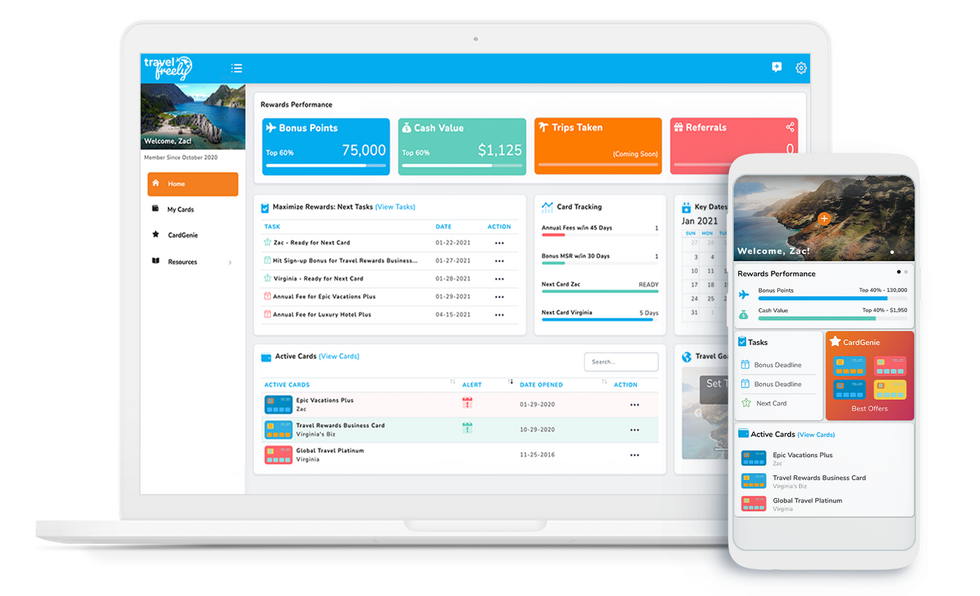
Not sure which Delta card (if any) fits your situation? Get a personalized recommendation from CardGenie® in a couple of minutes.
How to earn Delta SkyMiles
From flights
On Delta-marketed flights, regular members earn 5 miles per dollar spent. Elite members earn more: 7x at Silver, 8x at Gold, 9x at Platinum, and 11x at Diamond. A couple of exceptions earn miles based on distance flown instead of dollars spent, including most partner-airline flights and “exception fares” like vacation or cruise packages. Delta lists the specifics for partner flights and exception fares.
From credit cards
This is where beginners get the biggest win. A single card welcome bonus can hand you a large chunk of miles for spending you would do anyway, which is the heart of the Travel Freely approach. Earning miles from everyday spending on a Delta card, on the other hand, is usually not the best you can do, because other cards reward day-to-day spending more generously. The main exception is using the Reserve card to spend your way toward elite status, which we cover below.
By transferring points (the beginner-friendly path)
You do not have to earn SkyMiles directly. American Express Membership Rewards® points transfer to Delta at a 1-to-1 rate, and several Amex cards earn Membership Rewards faster than the Delta cards earn SkyMiles. So even if Delta is your goal, it can make sense to earn flexible Amex points first, then transfer when you are ready to book. As a bonus, flexible points keep your options open for other uses.
One thing to know: Amex charges a small “excise tax offset fee” of $0.0006 per point when you transfer to a U.S. airline like Delta, capped at $99. In practice that is small: about $6 for 10,000 miles, $30 for 50,000, $60 for 100,000, and $99 for 165,000 or more. Check out our American Express Membership Rewards Guide.
Marriott Bonvoy points also transfer to Delta, at 3 Marriott points per 1 mile. That ratio is generally weak, so it is rarely the best move, but it is there if you have a large Marriott balance.
Without flying at all
A few everyday activities earn a small number of SkyMiles once you link your accounts: booking Airbnb stays through Delta’s link (1 mile per dollar), renting from Hertz (4 or more miles per dollar), shopping through the SkyMiles Shopping online portal before you check out, and linking your Starbucks Rewards account (1 mile per dollar). None of these will fund a trip on their own, but they are easy extras if you already use those services.
How to use Delta SkyMiles

Booking is the easy part. On delta.com, check the “Shop with miles” box when you search for flights. Delta shows a week of results at a time, and you can click “Price Calendar” to see about five weeks at once and spot cheaper dates.
A few quick booking tips
- Compare round-trip versus one-way. Delta sometimes charges fewer miles for a round-trip than for two one-ways.
- Scroll and sort. The cheapest award is not always shown first, especially when partner flights are involved.
- Be careful with basic economy. Free award changes and cancellations do not apply to basic economy, so skip it if your plans might change.
- Keep a Delta card for the 15% discount. Any Delta Gold, Platinum, or Reserve card gets you 15% off award flights flown entirely by Delta.
The 15% cardholder discount (TakeOff 15)
If you hold a Delta Gold, Platinum, or Reserve card, Delta knocks 15% off the miles price on award flights (called “TakeOff 15”). It applies broadly to Delta-operated flights but not to itineraries that include partner airlines. It is one of the simplest ways to make your miles go further, and on its own it can offset a chunk of a card’s annual fee if you redeem regularly.
Getting good value
Award flights average around 1.1 cents per mile in value, or about 1.3 cents after the 15% cardholder discount. For beginners, the most reliable value tends to be in domestic economy flights, occasional Delta flash sales, and short economy hops within Europe. You can sometimes do better with the right redemption, but you do not need to chase exotic deals to come out ahead; a flight you would have paid cash for is already a win.
Partner airlines
You can use SkyMiles on Delta’s partner airlines whenever saver-level award space is available. Notable partners you can book online include Air France, KLM, Korean Air, Virgin Atlantic, LATAM, WestJet, and Aeromexico, among others. Partner awards can open up destinations Delta does not serve directly.
Miles + Cash
If you are a little short on miles, Delta will sometimes let you pay part in miles and part in cash. This effectively lets you buy the miles you are missing for roughly 1.8 cents each, which is not a great rate, so it is best used only when you are just shy of an award you want, not as a regular strategy.
Free changes and cancellations
For awards that start in North America, changes and cancellations are free. If you cancel, your miles go back to your account and any taxes you paid are refunded. If you change, the award is repriced (so you might owe more or fewer miles), but there is no change fee itself. This flexibility is especially handy for families and anyone whose plans can shift. NOTE: This does not apply to basic economy fares.
Using miles like cash
Delta cardholders can use “Pay with Miles” to cover part or all of a cash ticket at a flat 1 cent per mile, in 5,000-mile increments (every 5,000 miles knocks $50 off the price). A small tip: unless the fare is an exact multiple of $50, stop one increment short so you do not waste miles on the last few dollars. For example, on a $228 ticket, applying 20,000 miles brings it down to $28, which is better value than spending another 5,000 miles to erase that last $28. Delta Vacations packages can also be paid with miles at 1 cent each. Two things to avoid because they give poor value: redeeming miles for gift cards, and using miles to pay for seat upgrades.
What about elite status?
Delta has four elite tiers, from Silver up to Diamond, earned by reaching spending thresholds called Medallion Qualifying Dollars (MQDs) through flying and certain card spend. Perks scale with your tier and can include complimentary upgrades, better seat selection, waived fees, and lounge access at the top levels.
For most people just getting started, status is not the reason to use SkyMiles. The bigger, simpler wins are the welcome bonus and easy flight redemptions. That said, if status is a goal, the Platinum and Reserve cards offer a path that does not require heavy flying: they earn MQDs from your spending and include an annual head start toward status.
The bottom line
Delta SkyMiles will not win awards for the flashiest redemptions, but they are dependable and beginner-friendly: easy to book, hard to badly misuse, and backed by free changes and cancellations on most flights. If you are just starting out, the simplest move is to earn a single welcome bonus on a card that fits your spending, then redeem for a Delta flight you would have bought anyway. Flexible American Express Membership Rewards points are a smart on-ramp too, since they transfer to Delta when you need them.
Not sure where to begin? CardGenie® can suggest a card based on your situation in a couple of minutes. Travel Freely earns a commission if you apply through our links, at no cost to you, and we always show the best public offer, even when it does not earn us anything.
Note: This article was inspired by Frequent Miler. Content used with permission.